Indication and
Limitations of Use:
Parsabiv® (etelcalcetide) is indicated for the treatment of secondary hyperparathyroidism (HPT) in adult
patients with chronic kidney disease (CKD) on hemodialysis. Read More
Parsabiv® (etelcalcetide) is indicated for the treatment of secondary hyperparathyroidism (HPT) in adult
patients with chronic kidney disease (CKD) on hemodialysis.


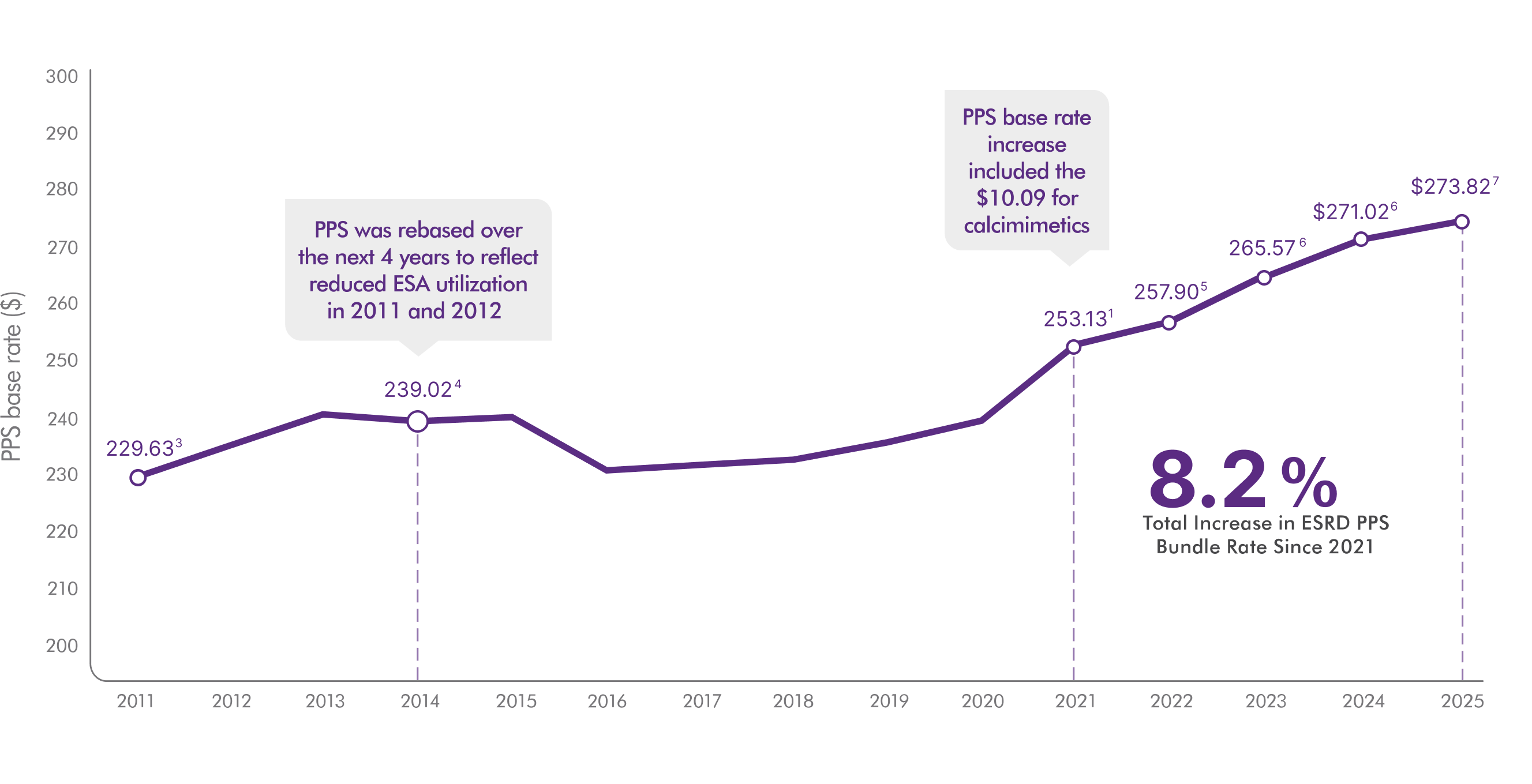
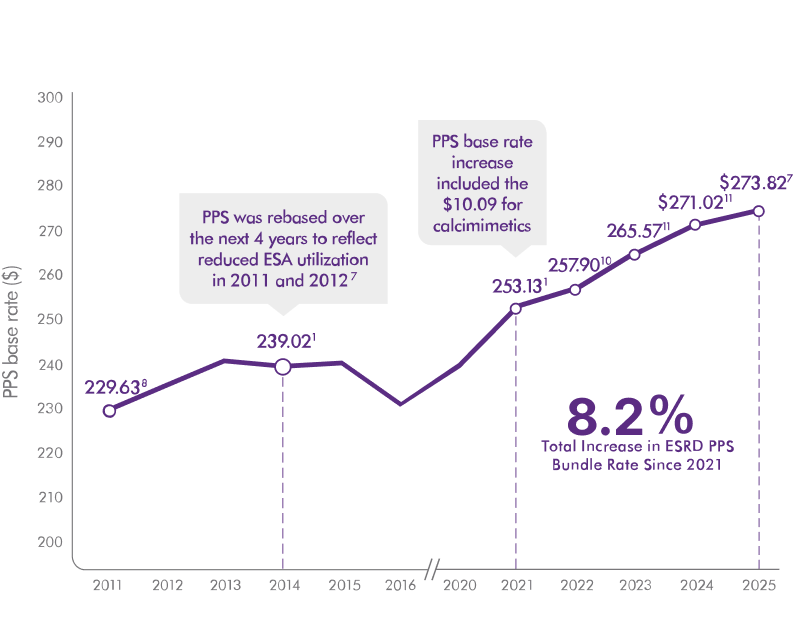
Now that Parsabiv® is reimbursed as part of the ESRD bundle, some organizations are limiting access. Dialysis organizations can think about reimbursement across all dialysis patients since the additional amount for calcimimetics is there for every single dialysis session, not just for dialysis sessions for patients prescribed Parsabiv®. Based on utilization at ~6.3% of dialysis sessions during the evaluation period, the $10.09 added to the ESRD bundle is designed to cover Parsabiv® for clinically appropriate patients. This amount is expected to grow annually with the bundle base rate increase.
The portion of the bundle not covered by Medicare will increase by the same percentage that the bundle increases to account for the cost of Parsabiv® and other dialysis costs. Reimbursement for Parsabiv®—and other dialysis costs—is adjusted annually by a market basket increase to the ESRD bundle. This will likely impact those patients who don’t have a secondary payer source. This Medicare policy is not specific to calcimimetics.
Talk with your medical director about the patients for whom Parsabiv® is the best fit, and make sure they and your care team understand Parsabiv® reimbursement. You can also reach out to your Parsabiv® representative on how to help start a conversation with your medical director for them to understand the reimbursement dynamics of Parsabiv®.
MA plans receive capitated payments to provide all Medicare‐covered services to pay enrollees, and they are responsible for covering calcimimetics for clinically appropriate patients. Coverage and reimbursement will vary based on an individual organization’s payer contracts. Reach out to your contracted payer or parent organization to determine how Parsabiv® will be covered. Getting coverage for Parsabiv® may require amending your dialysis organization’s payer contracts. Work with your contracting group to make the case for coverage for clinically appropriate patients when contracts are being negotiated.
Medicaid coverage varies by state. Check with your State Medicaid Office to understand coverage and requirements specific to your state.
Commercial coverage and reimbursement will vary. Verify payment details once you have identified clinically appropriate patients. Reach out to your contracted payer or parent organization to determine how Parsabiv® will be covered under your specific contract terms; contract amendments may be necessary. Work with your contracting group to make the case for coverage for clinically appropriate patients when contracts are being negotiated.
For financial support information and other resources for your patient, contact Amgen SupportPlus at (866) 264-2778 Monday through Friday, 8:30 am to 8:00 pm ET.
Contraindication: Parsabiv® (etelcalcetide) is contraindicated in patients with known hypersensitivity to
etelcalcetide or any of its excipients. Hypersensitivity reactions, including face edema and anaphylactic reaction,
have occurred.
Hypocalcemia: Parsabiv® lowers serum calcium and can lead to hypocalcemia, sometimes severe. Significant
lowering of serum calcium can cause QT interval prolongation and ventricular arrhythmia. Patients with
conditions that predispose to QT interval prolongation and ventricular arrhythmia may be at increased risk for
QT interval prolongation and ventricular arrhythmias if they develop hypocalcemia due to Parsabiv®. Closely
monitor corrected serum calcium and QT interval in patients at risk on Parsabiv®.
Significant reductions in corrected serum calcium may lower the threshold for seizures. Patients with a history of
seizure disorder may be at increased risk for seizures if they develop hypocalcemia due to Parsabiv®. Monitor
corrected serum calcium in patients with seizure disorders on Parsabiv®.
Concurrent administration of Parsabiv® with another oral calcimimetic could result in severe, life-threatening
hypocalcemia. Patients switching from cinacalcet to Parsabiv® should discontinue cinacalcet for at least 7 days
prior to initiating Parsabiv®. Closely monitor corrected serum calcium in patients receiving Parsabiv® and
concomitant therapies known to lower serum calcium.
Measure corrected serum calcium prior to initiation of Parsabiv®. Do not initiate in patients if the corrected serum
calcium is less than the lower limit of normal. Monitor corrected serum calcium within 1 week after initiation or
dose adjustment and every 4 weeks during treatment with Parsabiv®. Measure PTH 4 weeks after initiation or
dose adjustment of Parsabiv®. Once the maintenance dose has been established, measure PTH per clinical
practice.
Worsening Heart Failure: In Parsabiv® clinical studies, cases of hypotension, congestive heart failure, and
decreased myocardial performance have been reported. Closely monitor patients treated with Parsabiv® for
worsening signs and symptoms of heart failure.
Upper Gastrointestinal Bleeding: In clinical studies, 2 patients treated with Parsabiv® in 1253 patient years of
exposure had upper gastrointestinal (GI) bleeding at the time of death. The exact cause of GI bleeding in these
patients is unknown and there were too few cases to determine whether these cases were related to Parsabiv®.
Patients with risk factors for upper GI bleeding, such as known gastritis, esophagitis, ulcers or severe vomiting,
may be at increased risk for GI bleeding with Parsabiv®. Monitor patients for worsening of common Parsabiv® GI
adverse reactions and for signs and symptoms of GI bleeding and ulcerations during Parsabiv® therapy.
Adynamic Bone: Adynamic bone may develop if PTH levels are chronically suppressed.
Adverse Reactions: In clinical trials of patients with secondary HPT comparing Parsabiv® to placebo, the most
common adverse reactions were blood calcium decreased (64% vs. 10%), muscle spasms (12% vs. 7%), diarrhea
(11% vs. 9%), nausea (11% vs. 6%), vomiting (9% vs. 5%), headache (8% vs. 6%), hypocalcemia (7% vs. 0.2%), and
paresthesia (6% vs. 1%).
Indication
Parsabiv® (etelcalcetide) is indicated for the treatment of secondary hyperparathyroidism (HPT) in adult patients
with chronic kidney disease (CKD) on hemodialysis.
Limitations of Use: Parsabiv® has not been studied in adult patients with parathyroid carcinoma, primary
hyperparathyroidism, or with CKD who are not on hemodialysis and is not recommended for use in these
populations.
Please see Parsabiv® (etelcalcetide) full Prescribing Information.
Contraindication: Parsabiv® (etelcalcetide) is contraindicated in patients with known hypersensitivity to
etelcalcetide or any of its excipients. Hypersensitivity reactions, including face edema and anaphylactic reaction,
have occurred.
Hypocalcemia: Parsabiv® lowers serum calcium and can lead to hypocalcemia, sometimes severe. Significant
lowering of serum calcium can cause QT interval prolongation and ventricular arrhythmia. Patients with
conditions that predispose to QT interval prolongation and ventricular arrhythmia may be at increased risk for...
References: 1. CMS. 42 CFR Part 413. Medicare program; ESRD PPS, Payment for Renal Dialysis Services Furnished to Individuals with Acute Kidney Injury, and ESRD QIP. Final rule. 2. CMS.gov. Fact Sheet. CY19 ESRD/DME NPRM (CMS-1691-F) and DMEPOS competitive bidding program temporary gap period announcement; 2018. 3. DHHS. CMS. MLN Matters. 2011. 4. CMS.gov. Fact Sheet. CMS finalizes policies and payment rates for ESRD PPS for CY2014. 5. CMS. 42 CFR Parts 412, 413, and 512. Medicare program; ESRD PPS, payment for renal dialysis services furnished to individuals with acute kidney injury, ESRD QIP, and ESRD treatment choices model. Final rule. 6. Medicare program; ESRD PPS, payment for renal dialysis services furnished to individuals with acute kidney injury, ESRD QIP, and ESRD treatment choices model; 42 CFR Parts 413 and 512. (2023). 7. CMS.gov. Calendar Year 2025 End-Stage Renal Disease (ESRD) Prospective Payment System (PPS) Final Rule (CMS-1805-F). https://www.cms.gov/newsroom/fact-sheets/calendar-year-2025-end-stage-renal-disease-esrd-prospective-payment-system-pps-final-rule-cms-1805-f. Accessed October 10, 2025.